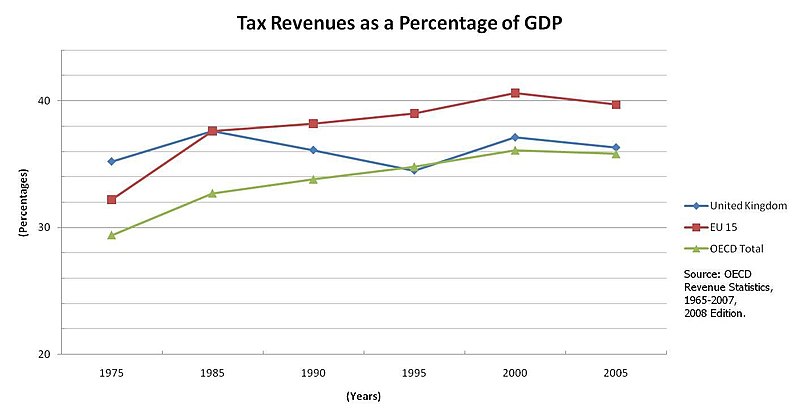
The central government revenues come primarily from income tax, national insurance contributions, value added tax, corporation tax and fuel duty.
The local government revenues come from grants from central government funds, business rates in England, Council Tax, and from fees and charges such as those from on-street parking.
Most of the developments in UK taxation have been in line with following things.
- the share of revenue provided by VAT has greatly increased, while the share provided by taxes on specific goods has fallen by a similar amount.
- basic and higher rates of income tax have been cut.
- new environmental taxes have been introduced.
But there are some unusual things.
- the UK applies a zero rate of VAT to many more goods than most other countries.
- an unusually small share of UK tax revenue comes from social security contributions but an unusually large share comes from recurrent tax on buildings( council tax and business rates).
A Land Tax was introduced in U.K. in the late 17th century. This was the main source of government revenue throughout the 17th, 18th, and 19th century.
And income tax was introduced by William Pitt the Younger in 1799, to pay for weapons and equipment in the preparation for the Napoleonic Wars. Income tax was levied under five schedules: Schedule A- tax on income from U.K. land
Schedule B-tax on commercial occupation of land
Schedule C-tax on income from public securities
Schedule D-tax on trading income, professions, vocations, overseas income
Scheduel E- tax on employment income
But Pitt's income tax was abolished by Henry Addington during the Peace of Amiens.
http://www.hmrc.gov.uk/rates/it.htm
http://www.ifs.org.uk/mirrleesreview/dimensions/ch1.pdf

댓글 없음:
댓글 쓰기